 https://www.theconduit.com/wp-content/uploads/2026/05/pexels-zelch-12498767-scaled.jpg
1440
2560
Programme Team
https://www.theconduit.com/wp-content/uploads/2024/01/Conduit-logo.svg
Programme Team2026-05-22 17:07:332026-05-22 17:10:10Plan C for Civilization: Film Screening and Discussion
https://www.theconduit.com/wp-content/uploads/2026/05/pexels-zelch-12498767-scaled.jpg
1440
2560
Programme Team
https://www.theconduit.com/wp-content/uploads/2024/01/Conduit-logo.svg
Programme Team2026-05-22 17:07:332026-05-22 17:10:10Plan C for Civilization: Film Screening and Discussion
Life, Death, and the Pursuit of Peace in Israel/Palestine
Robert Malley, diplomat and co-author of Tomorrow Is Yesterday, talks to Paul van Zyl about the hopes of the Oslo Peace Process, the horrors of the present and the delusions of all sides.
Few diplomats understand the complexity of high stakes Middle East negotiations better than Robert Malley. As the lead United States negotiator for the 2015 Iran nuclear agreement, Malley helped broker one of the most consequential diplomatic accords of the 21st century. The deal placed strict limits on Iran’s nuclear programme and created an unprecedented inspections regime in exchange for sanctions relief. Three years later, President Donald Trump withdrew from the agreement, prompting former President Barack Obama to warn that without it, the United States could face a stark choice between a nuclear armed Iran or another war in the Middle East.
Joining us at The Conduit, Robert Malley reflects on his experience at the centre of these defining diplomatic battles. Drawing on his time as chief negotiator on Iran under President Obama, as well as his years advising United States presidents on Israel and Palestine, Malley offers a rare insider’s perspective on the possibilities and constraints of American diplomacy in the region.
Malley is also the co-author, with analyst Hussein Agha, of the recent book Tomorrow Is Yesterday, a searching account of the Israeli Palestinian peace process. In the book, Agha and Malley draw on decades of engagement with Palestinian leaders and American administrations to argue that the two-state solution became an international objective only after it had lost political viability. They contend that United States policymakers often favoured technical formulas over confronting the deeper historical grievances at the heart of the conflict, and that the most recent cycles of violence are not aberrations but echoes of unresolved history. The divide, they suggest, is shaped less by maps and borders, and more by memory, identity, and emotion.
Malley is in conversation with The Conduit’s co-founder and CEO Paul van Zyl to revisit the making of the Iran nuclear deal, the political forces that later unravelled it, and assess what its rise and fall reveal about the enduring challenges of diplomacy in an increasingly fractured world. At a moment when conflict is once again spreading across the Middle East, this timely discussion examines the recent Teutonic shifts and what happens next on Iran, as well as how this impacts any sort of future peace process between Israelis and Palestinians, and the reconstruction of Gaza.
Speakers
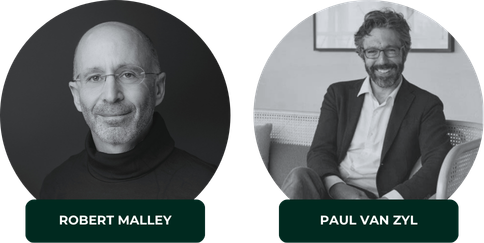
Robert Malley is a Senior Fellow and Lecturer at the Yale Jackson School of Global Affairs. He is the co-author, with Hussein Agha, of Tomorrow Is Yesterday: Life, Death, and the Pursuit of Peace in Israel/Palestine. A former U.S. diplomat, he served in the Biden, Obama, and Clinton administrations and was previously President and CEO of the International Crisis Group. He is a graduate of Yale University, Harvard Law School and Oxford University, England, where he was a Rhodes Scholar. He is also the author of The Call from Algeria: Third Worldism, Revolution and the Turn to Islam.
Moderated by Paul van Zyl, the co-founder and CEO of The Conduit. Paul is a winner of the prestigious Skoll Award for Social Entrepreneurship and was named a Young Global Leader by the World Economic Forum. He served as the Executive Secretary of South Africa’s post-apartheid Truth and Reconciliation Commission and co-founded the International Centre for Transitional Justice (ICTJ), an international human rights organisation based in New York City.
Share This Event
Upcoming Events
https://www.theconduit.com/wp-content/uploads/2026/05/pexels-zelch-12498767-scaled.jpg
1440
2560
Programme Team
https://www.theconduit.com/wp-content/uploads/2024/01/Conduit-logo.svg
Programme Team2026-05-22 17:07:332026-05-22 17:10:10Plan C for Civilization: Film Screening and Discussion https://www.theconduit.com/wp-content/uploads/2026/05/multiracial-hosts-streaming-podcast-together-at-ho-2026-01-08-05-44-35-utc-scaled.jpg
1706
2560
Programme Team
https://www.theconduit.com/wp-content/uploads/2024/01/Conduit-logo.svg
Programme Team2026-05-21 11:31:512026-05-21 11:31:51The Podcast Revolution: What Comes Next?
https://www.theconduit.com/wp-content/uploads/2026/05/multiracial-hosts-streaming-podcast-together-at-ho-2026-01-08-05-44-35-utc-scaled.jpg
1706
2560
Programme Team
https://www.theconduit.com/wp-content/uploads/2024/01/Conduit-logo.svg
Programme Team2026-05-21 11:31:512026-05-21 11:31:51The Podcast Revolution: What Comes Next? https://www.theconduit.com/wp-content/uploads/2026/05/Story-Centred-Leadership-1307--scaled.png
1280
2560
Programme Team
https://www.theconduit.com/wp-content/uploads/2024/01/Conduit-logo.svg
Programme Team2026-05-15 09:56:202026-05-15 09:56:20Story-Centred Leadership: Communicating Purpose and Building Connection
https://www.theconduit.com/wp-content/uploads/2026/05/Story-Centred-Leadership-1307--scaled.png
1280
2560
Programme Team
https://www.theconduit.com/wp-content/uploads/2024/01/Conduit-logo.svg
Programme Team2026-05-15 09:56:202026-05-15 09:56:20Story-Centred Leadership: Communicating Purpose and Building Connection https://www.theconduit.com/wp-content/uploads/2026/05/River-event--scaled.png
1280
2560
Programme Team
https://www.theconduit.com/wp-content/uploads/2024/01/Conduit-logo.svg
Programme Team2026-05-08 15:24:112026-05-08 15:24:11The Rights of UK Rivers: Reimagining their Future
https://www.theconduit.com/wp-content/uploads/2026/05/River-event--scaled.png
1280
2560
Programme Team
https://www.theconduit.com/wp-content/uploads/2024/01/Conduit-logo.svg
Programme Team2026-05-08 15:24:112026-05-08 15:24:11The Rights of UK Rivers: Reimagining their Future https://www.theconduit.com/wp-content/uploads/2026/05/Pride-in-our-Planet-Awards-1-scaled.png
1280
2560
Programme Team
https://www.theconduit.com/wp-content/uploads/2024/01/Conduit-logo.svg
Programme Team2026-05-08 14:50:032026-05-20 15:54:27Pride in Our Planet Awards
https://www.theconduit.com/wp-content/uploads/2026/05/Pride-in-our-Planet-Awards-1-scaled.png
1280
2560
Programme Team
https://www.theconduit.com/wp-content/uploads/2024/01/Conduit-logo.svg
Programme Team2026-05-08 14:50:032026-05-20 15:54:27Pride in Our Planet Awards https://www.theconduit.com/wp-content/uploads/2026/05/NEB-scaled.png
1280
2560
Programme Team
https://www.theconduit.com/wp-content/uploads/2024/01/Conduit-logo.svg
Programme Team2026-05-06 15:24:422026-05-13 13:31:02The Conduit Presents: The People’s Emergency Briefing
https://www.theconduit.com/wp-content/uploads/2026/05/NEB-scaled.png
1280
2560
Programme Team
https://www.theconduit.com/wp-content/uploads/2024/01/Conduit-logo.svg
Programme Team2026-05-06 15:24:422026-05-13 13:31:02The Conduit Presents: The People’s Emergency Briefing https://www.theconduit.com/wp-content/uploads/2026/05/Clover-Hogan-scaled.png
1280
2560
Programme Team
https://www.theconduit.com/wp-content/uploads/2024/01/Conduit-logo.svg
Programme Team2026-05-06 14:10:512026-05-07 15:27:12Beyond the Choir: Climate Messaging in a Polarised World
https://www.theconduit.com/wp-content/uploads/2026/05/Clover-Hogan-scaled.png
1280
2560
Programme Team
https://www.theconduit.com/wp-content/uploads/2024/01/Conduit-logo.svg
Programme Team2026-05-06 14:10:512026-05-07 15:27:12Beyond the Choir: Climate Messaging in a Polarised World https://www.theconduit.com/wp-content/uploads/2026/05/Odyseey-Ensemble-scaled.png
1280
2560
Programme Team
https://www.theconduit.com/wp-content/uploads/2024/01/Conduit-logo.svg
Programme Team2026-05-01 13:40:532026-05-21 12:41:12Refugee Week 2026: Odyssey Ensemble
https://www.theconduit.com/wp-content/uploads/2026/05/Odyseey-Ensemble-scaled.png
1280
2560
Programme Team
https://www.theconduit.com/wp-content/uploads/2024/01/Conduit-logo.svg
Programme Team2026-05-01 13:40:532026-05-21 12:41:12Refugee Week 2026: Odyssey Ensemble https://www.theconduit.com/wp-content/uploads/2026/05/Grow-Urban-Festival--scaled.png
1280
2560
Programme Team
https://www.theconduit.com/wp-content/uploads/2024/01/Conduit-logo.svg
Programme Team2026-05-01 12:15:502026-05-18 11:09:57Growing Resilient Urban Ecosystems
https://www.theconduit.com/wp-content/uploads/2026/05/Grow-Urban-Festival--scaled.png
1280
2560
Programme Team
https://www.theconduit.com/wp-content/uploads/2024/01/Conduit-logo.svg
Programme Team2026-05-01 12:15:502026-05-18 11:09:57Growing Resilient Urban Ecosystems

